BUILDERS: New EU project to design, test and validate Extended Producer Responsibility schemes for construction products
Construction and Demolition Waste (CDW) is Europe’s largest waste streams, yet the implementation of the EPR principle in the construction sector remains limited and fragmented. Where schemes do exist, they are fragmented and inconsistent across Member States, leaving producers, recyclers and authorities without the common rules needed to keep construction products and their materials in use.
The BUILDERS project — Building Up Industry Loops through Development, Evaluation, and testing of an Extended producer Responsibility Scheme for construction products — is an EU-funded Horizon Europe project worth 4 999 286.25 EUR that aims to design, test and validate robust, scalable and harmonised EPR schemes for the construction sector, with a focus on plastic construction products. It will develop eco-modulated fee structures, recyclability protocols and circular business models built around the 4Rs (reduce, reuse, repair, recycle), and integrate Digital Product Passports, GS1 standards and QR codes to make products traceable and schemes enforceable. Life Cycle and Social Life Cycle Assessment will quantify the environmental and social gains.
These solutions will be tested in real-world demonstrators across France, Belgium, Germany and the Netherlands, covering three product families (floorings, pipes and sanitary equipment) to prove their feasibility and transferability before feeding into harmonised EU policy recommendations for cross-border EPR.
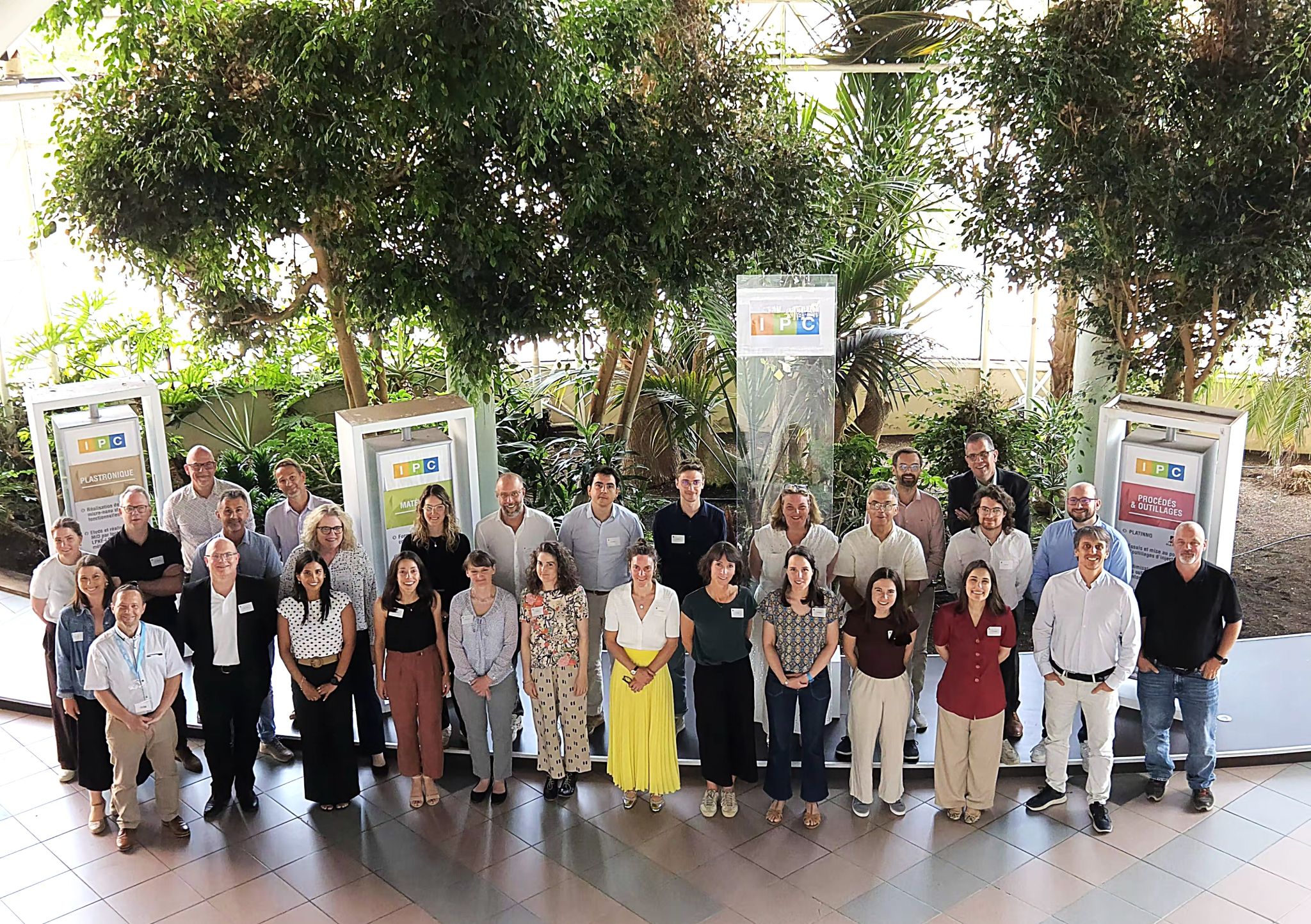
The consortium met on 16 and 17 June at coordinator IPC in France to launch the project. Over the two days, partners set out the work ahead, connected through introductory sessions, and took part in hands-on workshops on EPR for construction products, with a policy officer from the European Commission’s DG Environment and the project’s Project Officer from REA setting out the EU policy context. Partners also toured IPC’s plastics and composites facilities, previewing the processing and recycling capabilities that will support the project’s technical work.

The project, which started in June 2026, runs for 36 months and is coordinated by IPC (FR), together with TERRA (FR), VALOBAT (FR), BPIE (BE), Fraunhofer (DE), AIMPLAS (ES), Recycling Europe (BE), EI-JKU Linz (AT), ADEME (FR), GS1 in Europe (BE), ERFMI (BE), TEPPFA (BE), IVL (SE), Recovinyl (BE), TU Delft (NL) and CBRA (CH). By laying the foundations for a circular single market for construction products, BUILDERS will help make the sector more circular, competitive and sustainable.
For further information, please contact the coordinators at: florence.isnard@ct-ipc.com, marie.ranchon@ct-ipc.com.
Funded by the European Union. Views and opinions expressed are those of the author(s) only and do not necessarily reflect those of the European Union or the granting authority. Neither the European Union nor the granting authority can be held responsible for them.