As Hong Kong Convention enters into force, EuRIC asks the EU to lead on ship recycling standards

With the Hong Kong Convention (HKC) for the Safe and Environmentally Sound Recycling of Ships entering into force today, EuRIC urges the EU to push for stronger and more enforceable ship recycling rules both internationally and at EU level. While the HKC sets a basic framework, it remains inadequate. To ensure truly safe, environmentally sound recycling and to support the competitiveness of Europe’s ship recycling sector, stronger standards and stricter enforcement are urgently needed.
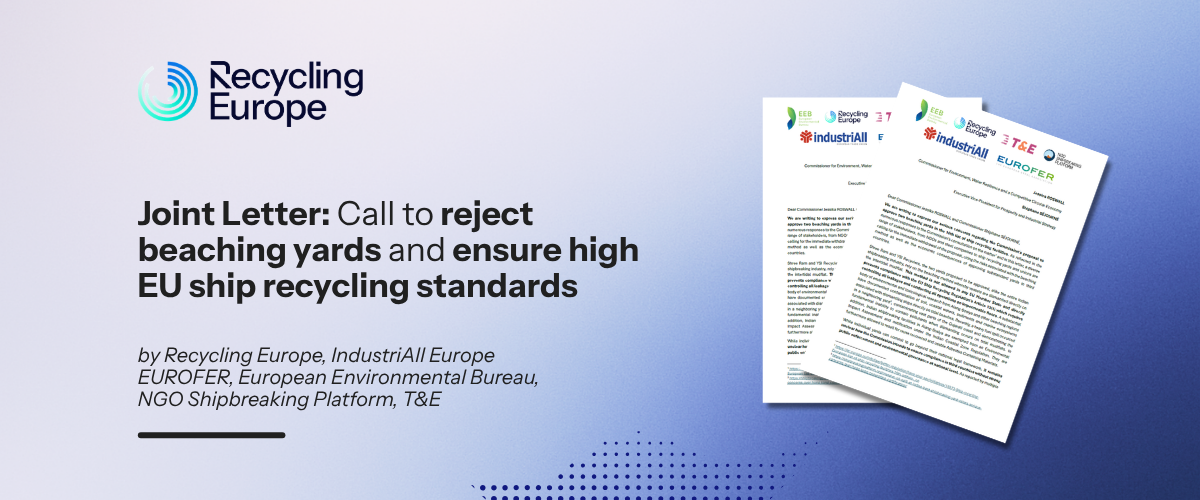
Adopted in 2009, the HKC marks a milestone in setting minimum global standards. However, it falls short in addressing key environmental, safety and circularity challenges. These shortcomings, flagged by the UN[1], and NGOs[2][3], limit its effectiveness and highlight the need for higher global requirements. In particular, the HKC allows for beaching – the dismantling of vessels directly on tidal shores without proper containment, posing serious risks to workers and the environment. While it sets general requirements for safety and environmental protection, it lacks clear operational standards, does not prohibit high-risk practices, and relies on flag states for enforcement. Its provisions are broad and often vague, leaving significant room for interpretation and weak oversight.
To address this, EuRIC calls on the European Commission and Members States to lead by example on the international stage by pushing for higher standards under the HKC, and ensuring it does not take precedence over the stricter Basel Convention that restricts the export of hazardous waste to non-OECD countries, thereby helping prevent illegal dumping and promoting safer, more sustainable dismantling practices.
At the EU level, the Ship Recycling Regulation (SRR), was adopted in 2018 to facilitate the ratification of the HKC. In its recent evaluation report of the Ship Recycling Regulation[4], the Commission concludes that the European legislation is more advanced in terms of ambitious standards for ship recycling compared to the HKC. Notably, the SRR includes stricter provisions on the environmentally sound and safe treatment of end-of-life vessels, such as the requirement to operate on built structures, stricter controls on hazardous materials (ensuring effective leakage control) and a wider scope of vessels and more materials included under the Inventory of Hazardous Materials (IHM).
Yet, while the SRR goes beyond the requirements of the HKC regarding certain issues, it remains insufficient to provide a robust regulatory framework for ship recycling. Thus, to make ship recycling safe, fair, competitive, and environmentally sound, both the Hong Kong Convention (HKC) and the EU Ship Recycling Regulation (SRR) must be strengthened.
EU yards comply with strict rules and higher standards that protect workers and the environment, but they are losing ground to low-standard facilities in South Asia due to weaker regulations and lower costs. As a result, the number of ships recycled in the EU has remained consistently low over the last decade and has even decreased in terms of the number of vessels recycled. This trend clearly shows that the current regulatory framework fails to establish a level playing field. Additionally, the widespread circumvention of the SRR continues to undermine its effectiveness and fails to support the growth of the ship recycling sector in the EU.
Without stronger enforcement and global alignment on standards, EU recyclers cannot compete, undermining both circular economy targets and the decarbonisation of Europe’s steel sector. The HKC’s entry into force must not lead to complacency; the EU must use this moment to raise the bar globally and fix the gaps in its own system.
[1] UN-special-rapporateur-on-Basel-IMO-conventions-comparison
[2] Press Release – NGOs warn that Hong Kong Convention will fail to ensure sustainable ship recycling
[3] ANALYSIS OF EQUIVALENCE UNDER THE BASEL CONVENTION AS APPLIED TO THE INTERNATIONAL CONVENTION FOR THE SAFE AND ENVIRONMENTALLY